


Apart from the heavy work on building and launching your website, the daily use of WordPress involves all kinds of small tasks that every one of us is facing each day, or at least very often.
In this long post, we are going to add every single one of these common questions and issues and try to give the most simple working solution. This guide will be for WordPress beginners and users with little experience with the CMS.
Delete Post Revisions
Why is it a good idea to delete old posts’ revisions?
With time, revisions can grow to a significant number and bloat your database. Every time you hit “Save draft”, WordPress keeps another full copy of the post. On a site that’s been running for a few years, it’s not unusual to find more rows of revisions than actual content.
By deleting old revisions you will reduce your database size and speed up your website.
Another option is to bulk delete all revisions. If that’s what you want, you can install the WP-Optimize plugin – it cleans revisions, spam comments, transients and auto-drafts in one pass.
But in this answer, I’ll show you how to easily delete only specific posts’ revisions, because you may want to keep some for later.
✔ Here’s How
Simple Revisions Delete adds a small “Purge” action next to the Revisions number in each post or page.

Simply click the link and it’s all done. Voila!
The plugin also has a bulk delete option if you want to get rid of all your posts’ revisions.
Stop the problem at the source. Deleting revisions is a cleanup, not a cure – they’ll pile up again. Add this line to your wp-config.php, above the “That’s all, stop editing!” comment, and WordPress will only ever keep the last 3 revisions of each post:
define( 'WP_POST_REVISIONS', 3 );Set it to false to turn revisions off completely – though I wouldn’t. Three is a good compromise between a lean database and being able to undo yesterday’s mistake.
Change the Default Admin Login URL

There are several reasons you’d want to change the default login URL of your WordPress site.
By default, all WordPress sites come with a login URL: yourdomain.com/wp-admin.
If you keep it that way there is a chance to let bots guess your credentials, get brute force attacks, and even if they fail to get in this will still eat server resources and can take your site down for a while.
✔ Here’s How
Install the Kadence Security plugin (you may know it as iThemes Security – more on the name in a second) and go to its settings.

Find the “Hide Backend” feature and open its settings. Just type your desired login address and save. That’s it – and don’t forget what you have typed.
A note on the name, because it has changed twice. This is the plugin that spent years as iThemes Security. It was rebranded to Solid Security, and today it’s listed on WordPress.org as Kadence Security. The slug never changed (better-wp-security), so it’s the same plugin you may already have installed – it just wears a different name in your plugins list now. It’s still one of the most installed security plugins out there, at roughly 700,000 active installs.
Worth being honest about what this fix does and doesn’t do: hiding the login URL stops the dumb automated bots that hammer /wp-login.php all day. It is not real security on its own. A strong password, two-factor authentication (next section but one) and keeping things updated do far more for you than a secret URL.
Add a Sticky (Fixed) Widget to the Sidebar

A sticky widget means a widget that scrolls down with the page.
If your posts are long, you will find that your widget area sits empty as the reader scrolls past your first few paragraphs.
Sticky widgets can increase your ads’ CTR and boost conversions.
✔ Here’s How (the no-plugin way)
This one used to need a plugin. It doesn’t anymore – every browser in use today supports position: sticky, so two lines of CSS in Appearance > Customize > Additional CSS will do it:
.sidebar .widget:last-child {
    position: sticky;
    top: 30px;
}
Replace .sidebar with whatever your theme calls its sidebar container – right-click the sidebar, choose Inspect, and you’ll see it in a second.
The plugin I originally recommended here was Q2W3 Fixed Widget. It still exists and still has around 80,000 users, but it hasn’t had an update since early 2023 and it’s only tested up to WordPress 6.2. It also predates the block-based widget screen that arrived in WordPress 5.8, which is where a lot of people hit trouble with it.
If you do go with it, the plugin adds a “Fixed widget” checkbox to every widget – you tick it and you’re done, no CSS involved:

It’ll probably still work for you. I just wouldn’t add a three-year-stale plugin to a site for something two lines of CSS handle natively.
How to enable Two-Factor Authentication (2FA) in WordPress
Like it or not, the internet is heading to a state where two-factor authentication is a security norm.
If you are using some popular apps and websites, the chance you’ve already faced 2FA is huge.
So why would you secure your Facebook profile and not your own website?
There are many ways, both free and premium, but we’ll focus on one plugin that does more than just that.
Enable Two-Factor Authentication in Kadence Security (FREE)
First, install and activate the plugin – the same one from the login URL section above.
Once you have it installed, go to the newly appeared “Security” tab in your menu, and click Settings.
Go to Features > Login security.

Turn on the Two-Factor Authentication option.
From the settings screen, select your preferred method.
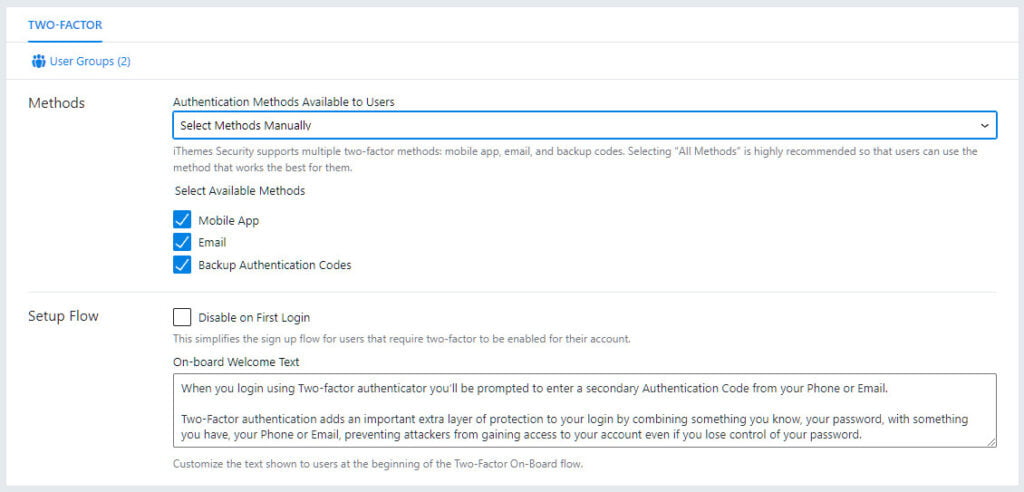
Download an authenticator app (Google Authenticator, Authy and 1Password all work the same way here), or stick with the e-mail codes every time you log in to your WordPress dashboard.
Congratulations!

Do this before you log out!
Download your one-time backup codes and keep them somewhere that isn’t your website. If you lose your phone without them, you lock yourself out of your own admin, and getting back in means editing the database by hand.
Increase the Maximum Upload File Size
“The uploaded file exceeds the upload_max_filesize directive in php.ini.” Sooner or later everybody meets this one, usually while trying to upload a theme or a video.
First, check what your limit actually is: Media > Add New shows it right under the upload box, and Tools > Site Health > Info > Media Handling gives you the full picture.
✔ Here’s How
The easy way: most hosts expose this in the control panel. In cPanel it’s under “Select PHP Version” > Options, where you can set upload_max_filesize and post_max_size yourself. Set both – raising only one gets you nowhere, and post_max_size should be the larger of the two.
If your host doesn’t allow it: open a ticket. It takes them thirty seconds and it’s a completely normal request.
The .htaccess way (Apache and LiteSpeed only, and some hosts block it):
php_value upload_max_filesize 64M
php_value post_max_size 128M
php_value max_execution_time 300
If your site returns a 500 error after adding those lines, your host doesn’t permit it – remove them and go back to the support ticket.
Find Out Which Plugin Is Slowing Down Your Site
Everyone’s first instinct is to deactivate plugins one by one until the site feels faster. That works, but it’s slow, unscientific, and you have to do it on a live site.
✔ Here’s How
Install Query Monitor. It’s free, it’s the tool actual WordPress developers use, and it adds a panel to your admin bar showing exactly where the page time went.
The two panels that matter to you:
- Queries by Component – shows how many database queries each plugin fired and how long they took. A plugin sitting at the top of this list on every single page load is your suspect.
- HTTP API Calls – shows plugins phoning external servers during a page load. This is the classic hidden killer: one plugin checking a licence server on every request can add a full second on its own.
Deactivate Query Monitor once you’ve found the culprit – it’s a diagnostic tool, not something to leave running on a production site.
Turn Off Comments Completely
If your site is a portfolio, a brochure site or a shop, comments are usually nothing but a spam magnet. Switching them off in Settings > Discussion only affects new posts, which is why people think it didn’t work.
✔ Here’s How
For existing content: go to Posts, select all, choose Edit from the Bulk actions dropdown, hit Apply, then set Comments to “Do not allow” and Update. Repeat for Pages and, if you run a shop, for Products.
For everything, forever: untick “Allow people to submit comments on new posts” in Settings > Discussion so nothing new arrives with comments enabled.
If you’d rather not do it by hand, the Disable Comments plugin handles the whole lot in one click, including stripping the comment form out of your theme templates.

The “How to” Guide – quick and simple tutorials on the common WordPress issues users face every day.
Got a small WordPress problem that drives you mad and isn’t answered here? Leave it in the comments and it may well end up as the next entry on this page.
Disclosure: Some of the links on the page may contain a ref code (affiliate links), that tells the other side that we have sent you. If you liked what we suggest and you make a purchase, we may receive a commission.
